Design Sprint Workshops

Design Sprint Workshops

A smarter way to align teams and test ideas

Align your team and accelerate innovation in days (not months)

Tired of great ideas dying in endless meetings? That frustrating feeling when your team is stuck, pulling in different directions, and unable to move past the same old roadblocks?

Our Microsoft Transformation Design Sprint cuts through organisational noise by aligning people, processes and technology around a clear AI‑driven vision. In just a few days, we turn scattered perspectives into a unified roadmap centered around Dynamics 365, Copilot, and agentic automation, so your teams leave with clarity, confidence, and solutions ready to build.

No more stuck projects. No more digital dead‑ends.
Just rapid alignment and transformation that actually moves.

We are currently delivering Design Sprints completely free-of-charge to public sector organisations. 

Who is a design sprint for?

Anyone who wants to foster collaboration, navigate complexity, and move quickly toward meaningful solutions:

  • Organisations operating in silos that need to create cross‑team collaboration
  • Teams tackling complex, multi‑departmental challenges across processes, data, and systems
  • Public‑sector bodies and private‑sector enterprises modernising with Microsoft technology
  • Anyone seeking a fast, structured, outcomes‑driven approach to problem‑solving and modernisation

Design Sprints are driven by the core principle of User-Centred Design (UCD). This means the entire process is focused on building a solution that genuinely meets your customers' needs and solves their problems. 

I would definitely recommend it. It's a good way of gathering different perspectives. It was fast-paced; which helped cut out a lot of the noise.
Scott Blyth
Project Manager, Communities Team, Fife Council

Case study: Fife Council

How Fife Council tackled complex service challenges in just five days

Fragmented systems, inconsistent referrals, and duplicated effort were slowing down service delivery across Fife Council. Through a focused design sprint, teams aligned, prototyped solutions, and tested them with real users - transforming how services could be delivered. This video captures their journey, the breakthroughs, and what’s next.


👉 Watch the full video to see how collaboration and rapid experimentation led to real change.

Why choose a design sprint?

De-risk your project

Stop guessing: validate your riskiest assumptions and test your core idea with real users before you invest in development.

Align your teams and organisation

End departmental silos and eliminate ambiguity by getting every key perspective in one room to make clear, collective, and decisive choices.

Develop solutions

Move beyond the usual constraints by rapidly generating, prioritising, and prototyping new ideas to tackle your most persistent challenges.

Make informed decisions

Quickly synthesise research, gain user insights, and collect actionable feedback to ensure your final solution is driven by evidence, not assumptions.

Ready to stop talking and start solving?

Fill out our short form and one of our specialists will be in touch to provide you with more detailed information, answer any specific questions you may have, and discuss how a Design Sprint could work for your organisation.

What can you expect from a Design Sprint?

I would definitely recommend it because getting everyone in a room, with all the different perspectives, is great.   
Gillian Walker
Lead Improvement Advisor, Fife Council

FAQs

What's the core goal of a design sprint?

To quickly answer a critical business question through design, prototyping, and testing with real users in a focused, time-boxed process.

Who needs to be on the sprint team?

A diverse team of 8 to 10 participants is required, including a Decider (the ultimate authority, such as a product owner or executive). We also strongly recommend including a representative from Security/IT or Data Protection to confirm technical limitations.

What's the most critical outcome of the sprint?

To create a tangible solution. The team collectively chooses the best concept from the sketches and quickly builds a realistic, clickable prototype that looks and feels real.

How much time do we need to commit?

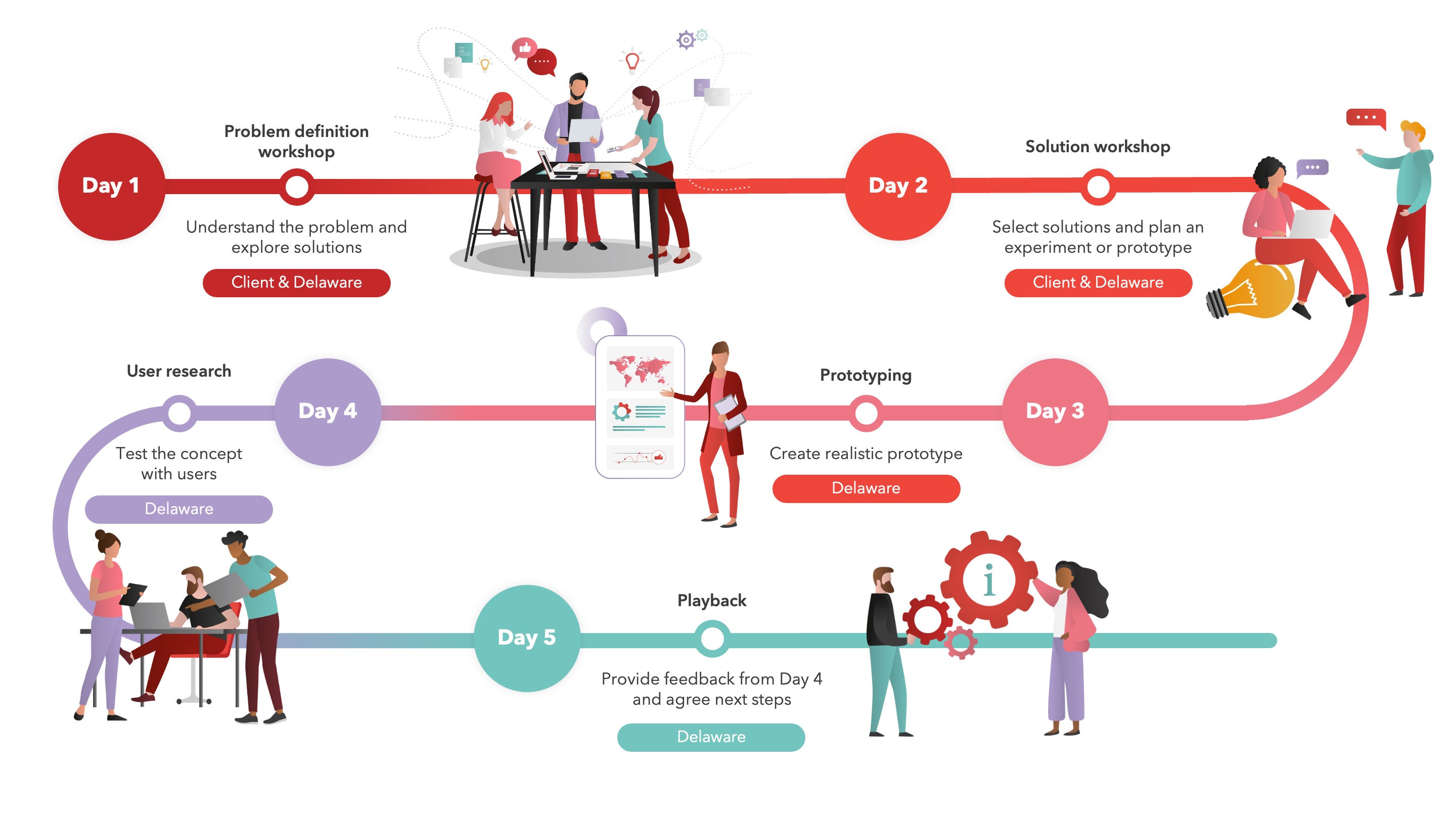
The Design Sprint typically requires two full days of dedicated, in-person attendance for the workshop, plus an additional day for user testing. While full commitment (no email/multitasking!) is essential, we offer flexibility to adjust the schedule based on your team's availability.

What should we prepare ahead of time?

To make the sprint a success, just bring three key things: a clear long-term goal, the specific problem you want to solve, and some customers scheduled for testing. Don't worry about repeating work - we always hold a preparation meeting first to review your processes and previous efforts, ensuring we hit the ground running!

What if the prototype fails in the user tests?

That's still a success! You've learned what doesn't work quickly and cheaply. The next step is an Iteration Sprint to refine the concept based on the feedback.

Customer Success Stories

J & E Davy: Optimising operations by moving to the cloud

Empowering their users: How Microsoft Copilot transformed information access for the UK division of VINCI Construction

Delivering up to 50% efficiency gains for Audley Group with Microsoft D365

Scope embraces digital transformation with Delaware