From Databases to Digital Teammates: The Future of CRM

Apr 27, 2026

For years, CRM promised to help organisations get to know their customers better, In reality it often got closer to a record-keeping system instead. 

For years, CRM promised to help organisations get to know their customers betterIn reality it often got closer to a record-keeping system instead. 

The future of CRM is not about flashy systems or more features. It’s about intelligence embedded into the flow of work, where AI doesn’t sit on top of the platform but lives inside it. In the Microsoft ecosystem, this shift is already well underway: Copilot is becoming the interface, agents are becoming active participants, and lowcode innovation is making it easier than ever to shape CRM around real human needs. 

  • Instead of asking users to adapt to CRM, modern platforms are adapting to users. 

  • Instead of waiting for instructions, agents observe, reason, and act (with guardrails). 

  • Instead of long development cycles, teams can “vibe code” lightweight wrappers that improve experience, adoption, and outcomes. 

This blog explores how Microsoft is redefining CRM from conversational Copilot experiences in Dynamics 365, to autonomous agents built with Copilot Studio, to usercentred enhancements delivered through the Power Platform. Not as a distant vision, but as a practical shift that is alreadyhappening across Frontier Firms. 

CRM is no longer just a system of record. It’s becoming a system of collaboration between people, data, and AI.
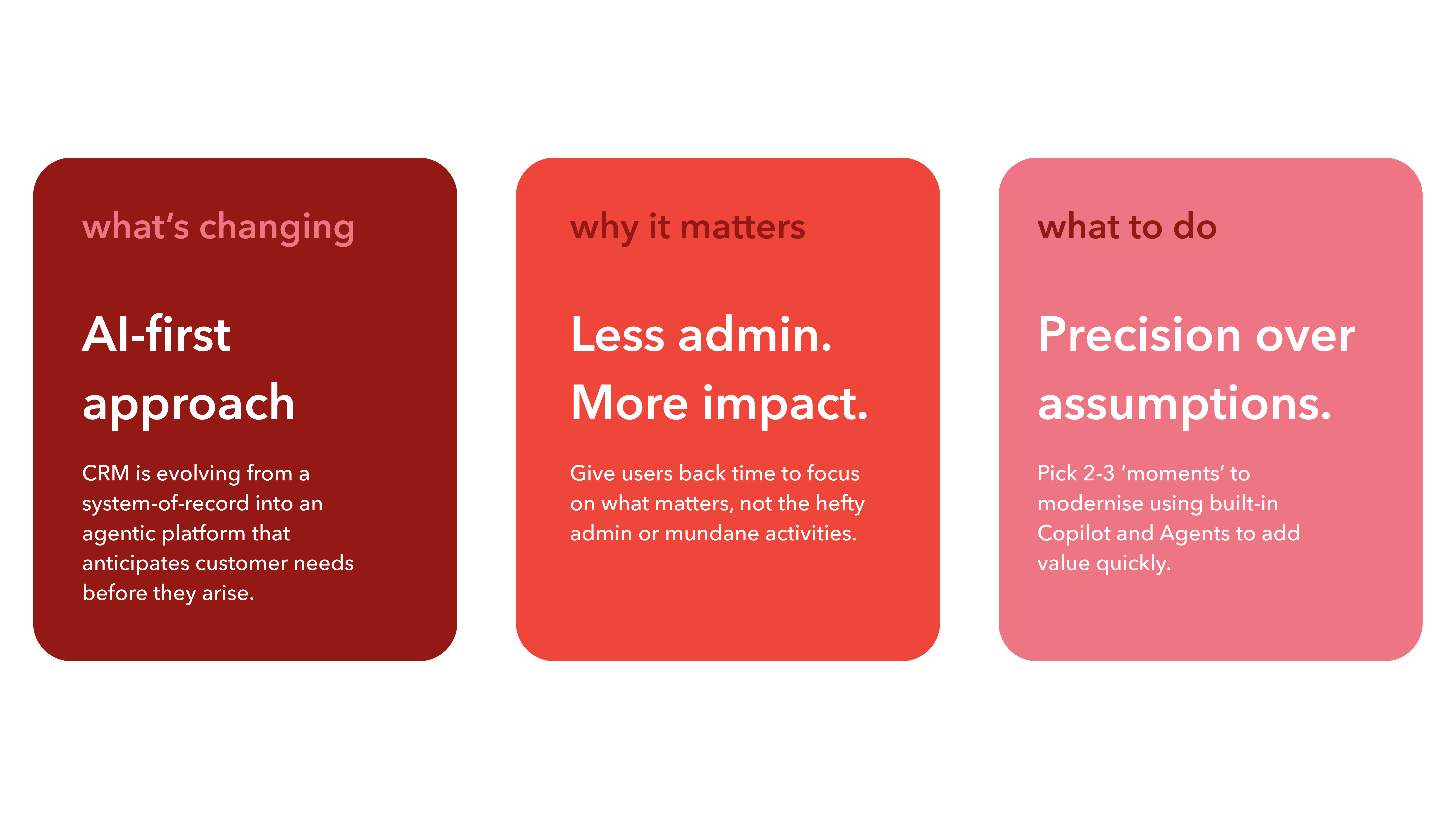
CRM used to be a place. Now it’s a teammate. 


Let’s be honest: traditional CRM has a reputation. It’s the place where good intentions go to die… usually somewhere between “Required Field” and “Save & Close.” 

But the Microsoft CRM ecosystem is moving toward something better, fast: AI embedded directly into everyday workflows, so the system doesn’t just store customer data it helps you use it. Microsoft’s direction is clear: Dynamics 365 brings together Copilot experiences, AI capabilities, and agents across CRM and ERP, built on a single, unified underlying platform.  


What changes in practice? 

  • Instead of searching and stitching context together, users can ask the solution in natural languageto generate meaningful insights.  

  • Agents can act autonomously actioning tasks. 

  • CRM becomes less “data entry” and more “decision support” going from a system of record to a system of action. 

  • Unified experiences across the tech stack help support your daily activities, not just in CRM and ERP but across tools such as Teams, Outlook and PowerPoint. This is where Microsoft technologies truly impact organisations and streamline end-to-end activity. 

What can AI actually do in CRM ? 

The first wave of modern CRM improvements focused on dashboards and automation. Helpful… but still clicky. The next wave is genuinely a gamechanger. 

What Copilot changes in CRM 
  • Summarise records and activity so users can catch up fast (e.g., work orders, service accounts, recent changes).  

  • Answer questions in natural language grounded in your CRM data, rather than forcing users to navigate menus and views.  

  • Keep work “in flow” by bringing Microsoft 365 Copilot chat into model-driven appsreducing the need to context-switch across tools.  

What Agents change in CRM 
  • Always on, always contextual: Agents monitor CRM signals (leads, cases, SLAs, renewals) in real time and surface the right insight or action at the right moment.  
  • From insight to action: Unlike traditional AI suggestions, agents can execute tasks routing work, drafting responses, triggering workflows often with human approval where needed.  
  • Human + AI collaboration: Agents don’t replace users; they reduce friction. People focus on judgement and relationships, while agents handle monitoring, orchestration, and routine execution. 

This is how CRM becomes more inclusive, new starters, occasional users, and busy leaders can get immediate value without memorising the system. 


Agents: when CRM stops assisting and starts doing 

If Copilot is the helpful colleague who drafts and summarises, Agents are the teammate who can actually take work off your plate. 


Microsoft Copilot Studio positions autonomous agents as systems that can perceive events, make decisions, and execute tasks using triggers, instructions, and guardrails you defineoperating in the background, not just responding in chat.  

Why agents are a big deal for CRM 


Agents shift CRM from “user-driven” to “outcome-driven.” Instead of waiting for a person to: 

  • notice something, 

  • interpret it, 

  • decide what to do, 

  • and then do it… 

Agents can monitor signals and act. Examples in CRM-shaped language: 

  • Lead follow-up agents that detect inactivity and trigger the right next step. 

  • Service triage agents that classify, summarise, and route cases with consistent logic. 

  • Renewal agents that watch contract dates and initiate outreach workflows automatically. 

Let’s not forget that Microsoft is explicit about doing this safely: autonomous agents should operate with scoped permissions, decision boundaries, auditability, and (for high-stakes actions) a human in the loop.  


The platform underneath: Dataverse  


AI is only as useful as the data it can trust. In Microsoft’s CRM world, Dataverse is the backbone that makes this work at scale. Dynamics 365 CRM apps run on Dataverse, which is why Copilot/AI capabilities in model-driven apps can light up across those experiences.  


We are now seeing a practical bridge between AI agents and real CRM data through Model Context Protocol (MCP) support so agents can interact with Dataverse more directly and consistently. Microsoft documentation describes connecting to Dataverse using an MCP server in Copilot Studio, enabling natural language interaction like “show me my contacts” grounded in stored data.  

What this means for the future CRM architecture: 
  • CRM data becomes more “AI-ready” when it’s well-modelled and governed. 

  • Agents become more reliable when they can access the right tools/data with least privilege 

Better Experiences, Better Outcomes. 


Here’s the fun part: the future isn’t just what Microsoft ships, it’s what you can build around it, quickly. 

With Copilot in Power Apps, makers can create apps and data models using natural language, generating Dataverse tables and app experiences without writing code.  

What is “vibe coding”  
  • Describe the experience you want (“I want a simple renewal workspace with next-best actions…”) 

  • Generate the starter UX, data structure, or automation 

  • Refine iteratively with Copilot until it feels right 

There is no one size fits all anymore, wrappers enable organisations to create: 

  • A role-based seller workspace that hides complexity and surfaces the next action 

  • service wrap that guides triage with the right knowledge, prompts, and automations 

  • A lightweight exec view that turns CRM into outcomes, not rows 

This is where adoption gets easier because you build the CRM people want to use, not the one they tolerate. 

What does the future CRM actually feel like? 

Let’s paint the picture: 

  • Less admin, more momentum: automatic summaries, suggested actions, fewer “blank page” moments.  

  • More proactive: agents monitoring pipelines, service queues, renewals, and nudging the right step at the right time.  

  • Seamless experiences: not matter what role in an organisation accesses CRM, it’s intuitive and easy to use daily. 

  • More governed: autonomy with permissions, guardrails, audit trails, and human approvals where it matters.  

CRM is becoming less like a filing cabinet and more like a satnavIt’s still your journey, but with smarter directions. 


What’s next? 

If you’re thinking about the future of CRM, don’t start with “Which features do we need?” Start with: 

  • Which moments in the customer journey should be conversational? (Copilot)  

  • Which tasks should run without being asked? (Agents / Automation 

  • Which roles need a simpler, modern experience? (app experiences) 

Take a step closer to a system of action

Find out more on how we can help you move towards AI readiness and harness agents across your workflows.